Call centers sit at the heart of many customer experiences. But as volumes rise and customer expectations climb, relying solely on manual work can strain teams and budgets. That is exactly where what is call center automation comes in.
Done well, automation does not replace your people. Instead, it streamlines repetitive tasks, speeds up service, and supports AI-powered omnichannel contact center strategies, while enhancing agent productivity with virtual agent assist. The result is faster support, happier customers, and a more motivated team.
Beyond simply handling calls, modern call center solutions integrate advanced technologies to ensure every interaction counts. Companies that invest in enterprise computing and high-performance systems gain a competitive edge by handling larger data loads more efficiently. These systems work behind the scenes to optimize routing, reduce downtime, and support smoother customer journeys.
For organizations looking to scale rapidly, insights from supercomputer technology and analytics platforms provide a roadmap for processing vast amounts of customer information in real-time. This ensures that agents always have the right context and recommendations, helping them deliver precise, timely responses.
Marketing strategies also benefit from automation. Integrating tools that support customer-centric marketing for call centers allows teams to track engagement, anticipate needs, and deliver personalized experiences. Over time, this not only improves satisfaction but also strengthens brand loyalty.
Small tweaks in workflow management and communication can make a huge difference. Platforms featured on marketing runners for business growth provide practical tips for combining automation with human insight, ensuring agents are both productive and empowered.
Finally, financial and operational efficiency is essential for long-term success. Leveraging resources such as top financial management tips for call centers helps organizations forecast accurately, reduce operational costs, and reinvest in strategies that improve customer interactions.
Top 10 Contact Center Solutions for Modern Businesses
When exploring what is call center automation, choosing the right platform can make all the difference. From AI-driven routing to omnichannel support, these solutions help businesses deliver faster, smarter, and more personalized customer experiences. Here are the top 10 contact center solutions in the market today:
1. Bright Pattern
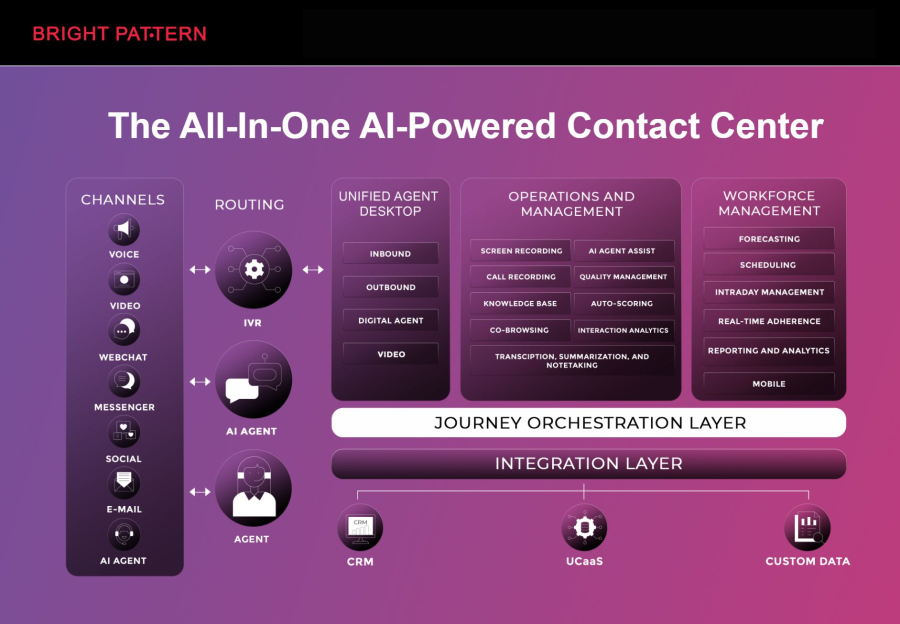
Bright Pattern stands out as a leading AI-powered contact center solution that simplifies what is call center automation for businesses of all sizes. It combines advanced automation with human agent support to enhance customer interactions and improve agent productivity.
Key features include:
- Omnichannel support across voice, chat, email, and social media
- AI-assisted routing and workflow automation
- Virtual agent assist to reduce agent workload and increase efficiency
- Real-time analytics and reporting to optimize performance
- Easy integration with CRM and other enterprise tools
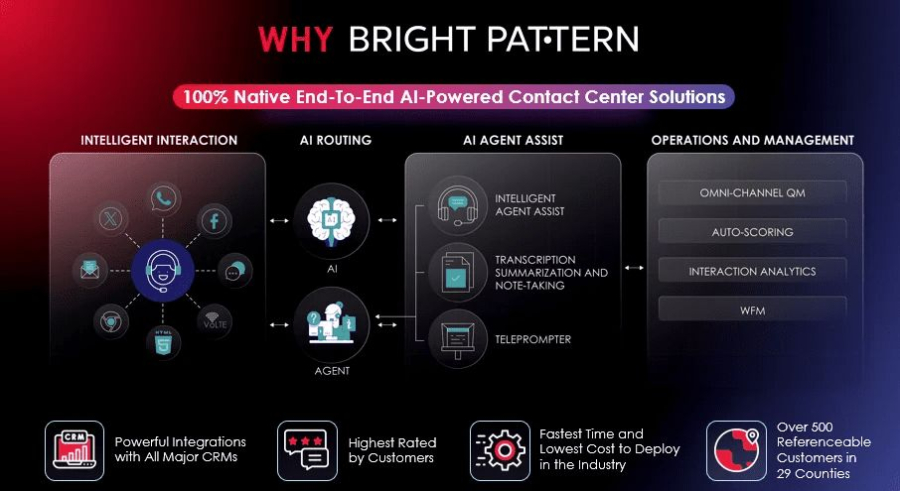
Bright Pattern empowers contact centers to reduce repetitive tasks, speed up service, and focus on high-value conversations, making it a top choice for organizations seeking modern AI contact center solutions.
2. Five9
Five9 provides cloud-based contact center software that enables AI-driven automation and omnichannel communication. It helps businesses streamline operations while maintaining personalized customer interactions.
3. Genesys Cloud CX
Genesys Cloud CX offers a flexible platform for contact centers to implement AI-powered automation and workforce optimization. Its advanced routing and analytics help improve both agent productivity and customer satisfaction.
4. NICE inContact
NICE inContact delivers cloud contact center solutions with AI-enhanced capabilities. It supports omnichannel communication and real-time performance management, helping businesses optimize workflows and customer experience.
5. Talkdesk
Talkdesk provides AI-powered call center solutions with automation features designed to reduce wait times, assist agents, and provide actionable insights. Its platform integrates seamlessly with enterprise software.
6. RingCentral Contact Center
RingCentral offers a cloud-based contact center solution that combines automation with unified communication. It focuses on improving agent efficiency and delivering seamless customer interactions.
7. 8x8 Contact Center
8x8 Contact Center provides AI-assisted call center automation and analytics. It supports multichannel communication, helping businesses respond quickly and accurately to customer needs.
8. Avaya OneCloud
Avaya OneCloud combines cloud contact center technology with AI-driven automation. It enhances agent productivity and ensures a consistent customer experience across channels.
9. Cisco Contact Center
Cisco Contact Center solutions offer robust AI and automation capabilities for enterprises. It supports predictive routing, chatbots, and advanced analytics to optimize performance and customer satisfaction.
10. Zendesk Support Suite
Zendesk Support Suite delivers a unified contact center solution that integrates AI-driven automation. It helps agents manage inquiries efficiently while providing personalized customer service across multiple channels.
What Is Call Center Automation?
Call center automationis the use of software, artificial intelligence, and predefined workflows to handle or assist with tasks that would otherwise require manual effort from agents or supervisors.
These tasks can include:
- Answering and routing incoming calls based on caller needs
- Authenticating customers and pulling up their account information
- Providing self-service options for common questions
- Guiding agents with scripts, prompts, and next best actions
- Logging call notes and updating CRM records
- Automating quality monitoring and performance reporting
- Triggering follow‑up messages, surveys, or outbound calls
The core idea is simple: let technology handle the repetitive, rules‑based work so humans can deliver empathy, problem‑solving, and relationship building.
How Call Center Automation Works
Modern call center automation combines several technologies that work together as an integrated system. While every operation is unique, most automation programs are built on a few common components.
1. Interactive Voice Response (IVR)
Interactive Voice Responsesystems greet callers and help them navigate to the right resource. Traditional IVRs use keypad inputs (for example, "Press 1 for billing"), while more advanced systems use speech recognition so callers can speak naturally.
IVR automation can:
- Identify the reason for the call
- Offer self‑service options (such as balance checks or order status)
- Authenticate callers before connecting them to an agent
- Route calls to the most appropriate queue or specialist
2. Automatic Call Distribution (ACD)
Automatic Call Distributionautomatically routes incoming calls to available agents based on rules you define, such as:
- Language or region
- Skill level or specialization
- Customer priority or account status
- Time of day or campaign
ACD ensures the right calls reach the right people quickly, reducing wait times and transfers.
3. AI‑Powered Virtual Agents and Chatbots
Virtual agentsandchatbotsuse natural language understanding to converse with customers via voice or text. They handle routine interactions end‑to‑end or assist human agents with instant information.
Common uses include:
- Answering FAQs (such as hours, policies, or pricing ranges)
- Capturing basic details before a handoff to a live agent
- Guiding customers through simple troubleshooting steps
- Providing order status, delivery updates, or appointment information
4. Robotic Process Automation (RPA)
Robotic Process Automationuses software robots to mimic human actions across multiple systems. In a call center, RPA can:
- Open and update customer records during or after calls
- Copy data between CRM, billing, and ticketing tools
- Trigger workflows (such as refunds, replacement orders, or plan changes)
- Generate and send confirmation emails or text messages
By offloading these steps, agents spend more time with customers and less time clicking through screens.
5. Knowledge Bases and Agent Assist
A well‑designedknowledge basestores articles, troubleshooting guides, and scripts.Agent assisttools layer AI on top of this content to surface relevant information in real time while the conversation is happening.
This can look like:
- Suggested answers based on what the customer just said
- Prompts to ask clarifying questions
- Recommendations for upsell or retention offers
- Automatic summarization of the call when it ends
6. Workforce and Quality Management Automation
Automation also enhances back‑office operations.Workforce managementtools forecast call volumes, create optimized schedules, and adjust staffing in real time.Quality managementtools automatically score interactions, identify coaching opportunities, and capture best‑practice examples.
Key Benefits of Call Center Automation
When thoughtfully designed, call center automation unlocks value across the entire operation, from customer satisfaction to profitability.
1. Faster, More Convenient Customer Service
- Shorter wait times.Automated routing, IVR, and self‑service options reduce queues and help customers get assistance faster.
- 24/7 availability.Virtual agents, chatbots, and self‑service workflows can operate around the clock, even outside normal business hours.
- Consistent answers.Centralized knowledge and scripted flows ensure customers receive accurate, up‑to‑date information.
2. Higher Agent Productivity and Job Satisfaction
- Less repetitive work.Automation handles routine lookups and data entry, letting agents focus on meaningful conversations.
- Smarter guidance.Agent assist tools provide real‑time suggestions so agents feel supported instead of overwhelmed.
- More time for complex issues.Because common tasks are automated, agents can spend extra time resolving the problems that matter most to customers.
3. Lower Operating Costs
- More calls handled per agent.With faster wrap‑up and fewer manual steps, each agent can successfully handle more contacts per shift.
- Deflected calls.Self‑service and virtual agents resolve common issues without ever reaching a human agent.
- Reduced errors.Automated processes lower the risk of costly mistakes from manual data entry or misrouted calls.
4. Improved Data Quality and Insights
- Automatic logging.Systems can automatically capture call outcomes, sentiment indicators, and reasons for contact.
- Centralized information.Integrations keep CRM, ticketing, and billing systems in sync, providing a single, reliable view of each customer.
- Better reporting.Richer data enables advanced analytics, forecasting, and performance optimization.
5. Stronger Compliance and Risk Management
- Standardized scripts.Automated prompts help agents follow required disclosures and regulatory language consistently.
- Secure workflows.Automation can enforce identity verification, consent capture, and data handling procedures.
- Auditable records.Automated logs and transcripts make it easier to respond to audits and investigations.
Common Types of Call Center Automation
Automation can show up in many parts of your operation. Below are some of the most common categories and examples.
1. Customer Self‑Service Automation
- Menu‑based and speech IVR for routing and simple tasks
- Virtual agents for password resets, order status, and basic troubleshooting
- Automated callbacks that hold your place in line and call back when an agent is free
- Proactive notifications about deliveries, outages, or appointment reminders
2. Agent Assist and Desktop Automation
- Real‑time script guidance and suggested responses
- Automatic screen pops with customer data when a call connects
- Background bots that update multiple systems at once
- Automated call summaries and disposition codes after each interaction
3. Operational and Management Automation
- Call and contact forecasting based on historical data and trends
- Dynamic queue management and skill‑based routing
- Automated quality scoring on a sample or all calls
- Performance dashboards that update in real time
4. Outbound and Follow‑Up Automation
- Predictive and power dialers for outbound sales or collections
- Automatic post‑interaction surveys via text or email
- Follow‑up reminders and task creation for agents
- Renewal, upsell, or retention campaigns triggered by customer behavior
Real‑World Use Cases for Call Center Automation
To make the concept more concrete, here are some practical ways organizations across industries use call center automation every day.
Use Case 1: Order Status and Delivery Updates
- Customers call or message to check where their order is.
- IVR or a virtual agent authenticates the caller and retrieves order details.
- The system shares real‑time status, estimated delivery date, and any delays.
- If needed, it offers options to update delivery instructions or connect to a live agent.
Result: A high volume of routine queries are resolved instantly, freeing agents for complex service issues or sales opportunities.
Use Case 2: Appointment Scheduling and Reminders
- Customers receive automated reminders about appointments by phone or text.
- They can confirm, cancel, or reschedule through self‑service options.
- If rescheduling is required, a virtual agent accesses a calendar and offers available time slots.
- Systems automatically update internal calendars and send confirmations.
Result: Fewer no‑shows, less manual scheduling work, and smoother experiences for both customers and staff.
Use Case 3: Technical Support Triage
- A customer contacts support with a technical problem.
- Automated triage asks a short series of questions to determine the issue type and urgency.
- Based on the answers, the system either guides the customer through self‑service steps or routes them to an appropriately skilled agent.
- Agent assist tools surface relevant troubleshooting flows once the call connects.
Result: Faster resolution, fewer transfers, and higher first‑contact resolution rates.
Use Case 4: Proactive Customer Communications
- Systems detect events such as a service outage, shipping delay, or upcoming renewal.
- Automated outbound messages inform affected customers and offer next steps.
- Customers can respond to reschedule, update preferences, or request a callback.
- Only the customers who need additional help end up speaking with agents.
Result: Reduced inbound spikes, more transparent communication, and improved customer trust.
Steps to Get Started With Call Center Automation
Implementing automation does not have to be overwhelming. A phased, outcome‑driven approach helps you deliver quick wins while building a long‑term foundation.
Step 1: Clarify Your Goals
Begin by defining what success looks like. Examples of goals include:
- Reducing average handle time by a specific percentage
- Improving first‑contact resolution rates
- Deflecting a portion of routine calls to self‑service channels
- Enhancing customer satisfaction scores
- Improving agent retention and engagement
Step 2: Map Current Journeys and Processes
Document how customers currently interact with your contact center and how agents complete their work. Look for:
- Repetitive steps in every interaction
- Manual data entry across multiple systems
- Common reasons for contact that could be automated
- Bottlenecks causing delays or long handle times
Step 3: Prioritize High‑Impact Use Cases
Not every task should be automated first. Prioritize opportunities where:
- Volume is high and interactions follow clear rules
- Customer expectations are focused on speed and convenience
- Agent effort is mostly repetitive rather than consultative
- Benefits can be measured in a straightforward way
Step 4: Select the Right Technologies
Based on your goals and priority use cases, choose tools that align with your strategy. Consider factors such as:
- Compatibility with your existing telephony and CRM systems
- Support for your preferred channels (voice, chat, messaging, email)
- Ease of configuration and management by non‑technical staff
- Scalability as volumes and use cases grow
Step 5: Design With the Customer and Agent in Mind
Effective automation feels simple, intuitive, and human‑centered. When designing IVR menus, chat flows, or agent assist prompts:
- Use clear, concise language and avoid jargon.
- Offer easy ways to reach a human when needed.
- Test with real customers and agents, then refine iteratively.
- Ensure experiences are consistent across channels.
Step 6: Launch, Measure, and Improve
Start with a pilot, measure outcomes, and then expand. Use data to refine prompts, routing rules, and workflows. Continue to involve frontline agents in feedback loops so automation keeps improving their day‑to‑day work.
Key Metrics to Track for Automated Call Centers
To understand the impact of automation, monitor a combination of efficiency, quality, and experience metrics.
- Average handle time (AHT).Track whether automation is reducing the time needed to resolve issues without harming quality.
- First‑contact resolution (FCR).Measure how often customer needs are fully resolved in a single interaction.
- Self‑service containment rate.See what percentage of interactions are fully resolved through self‑service or virtual agents.
- Customer satisfaction (CSAT) and Net Promoter Score (NPS).Monitor how customers feel about their experience after changes.
- Agent productivity and utilization.Evaluate contacts handled per agent, but also consider employee satisfaction and engagement.
- Call deflection and cost per contact.Compare the cost of automated versus live‑agent interactions.
Common Myths About Call Center Automation
As automation becomes more common, a few persistent myths can hold organizations back. Clarifying these can help you design a more confident strategy.
| Myth | Reality |
| Automation replaces human agents. | Well‑designed automation offloads repetitive tasks so humans can focus on empathy, negotiation, and complex problem‑solving. |
| Customers dislike all automated systems. | Customers dislikebadautomation. They appreciate fast, clear self‑service when it solves their issue quickly and offers an easy path to a human. |
| Automation is only about cutting costs. | Many organizations invest in automation primarily to improve customer experience, consistency, and scalability. |
| Automation requires a complete technology overhaul. | Many solutions integrate with existing platforms and can be rolled out gradually, use case by use case. |
The Future of Call Center Automation
Call center automation continues to evolve quickly, driven by advances in artificial intelligence, machine learning, and cloud technology. Some emerging trends include:
- More natural conversations.Improvements in speech recognition and natural language processing enable virtual agents to understand context and intent more accurately.
- Omnichannel orchestration.Automation will connect the dots across voice, chat, messaging, email, and in‑app interactions so customers can move between channels seamlessly.
- Hyper‑personalization.Systems will use customer history and preferences to tailor routes, offers, and responses in real time.
- End‑to‑end workflow automation.Instead of automating only parts of an interaction, more journeys will be automated from first contact through fulfillment.
- Deeper agent augmentation.Agent assist tools will provide even richer suggestions, coaching, and real‑time training to uplift performance across the entire team.
Bringing It All Together
Call center automation is no longer a nice‑to‑have; it is a powerful lever for delivering faster, more consistent service while creating a better workplace for agents. By combining technologies such as IVR, AI‑powered virtual agents, RPA, and agent assist, organizations can transform their contact centers from cost centers into strategic assets.
Starting small, focusing on high‑impact use cases, and designing with both customers and agents in mind will help you unlock the full potential of automation. When technology and people work together, every interaction becomes an opportunity to build loyalty, grow revenue, and differentiate your brand.
